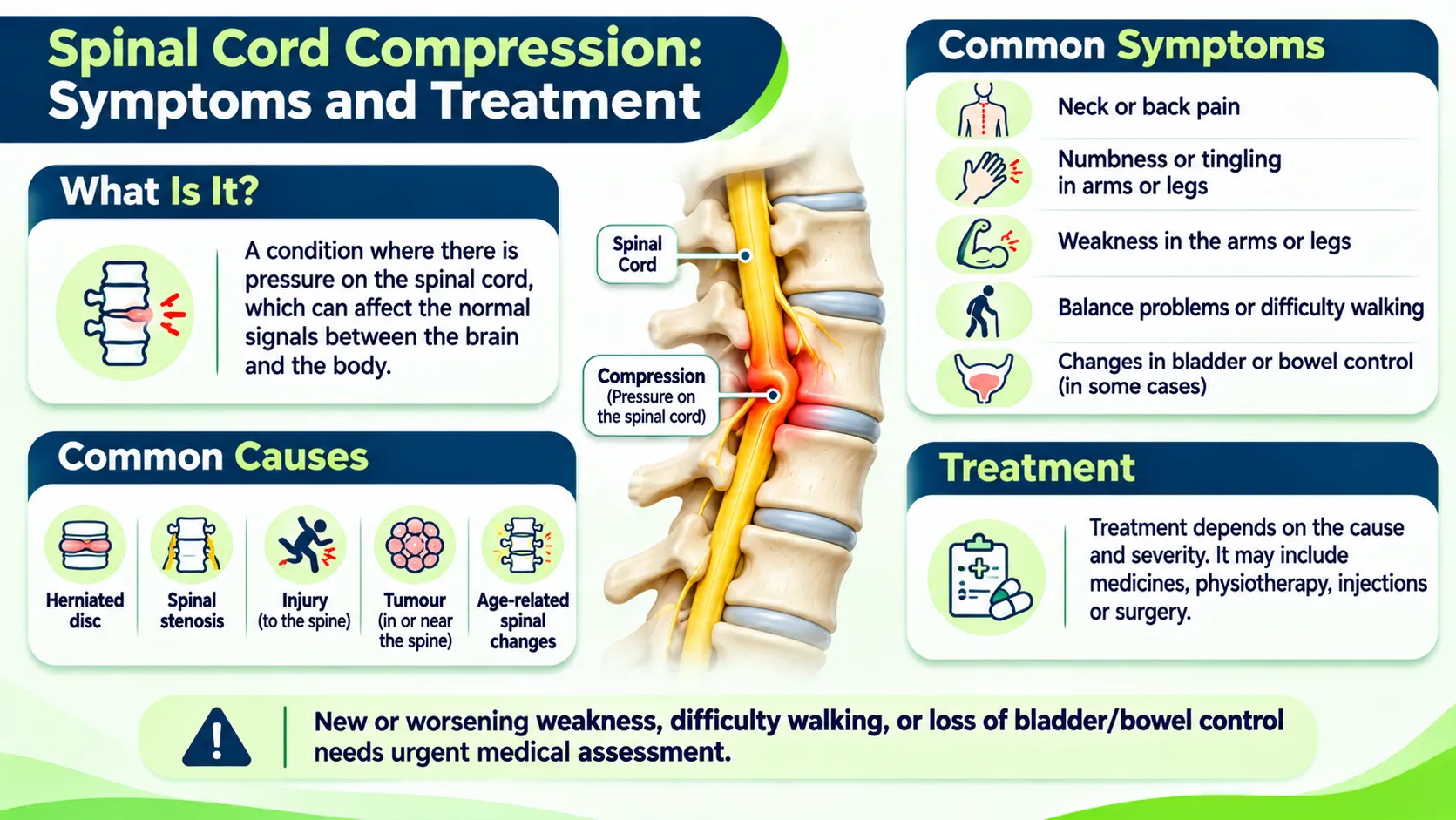
Dropping objects, struggling to fasten buttons, or feeling unsteady while walking may seem like minor issues. However, these symptoms can sometimes be early signs of spinal cord compression, a condition that occurs when pressure on the spinal cord affects the signals travelling between the brain and the body.
The spinal cord runs through a protective canal in the spine. Conditions such as herniated discs, bone spurs, spinal injuries, or tumours can narrow this space and put pressure on the cord. As a result, a person may experience changes in movement, sensation, balance, or even bladder and bowel control.
Spinal cord compression should not be ignored. Without timely medical evaluation and appropriate treatment, severe or prolonged compression can lead to lasting nerve damage. Symptoms may develop gradually or appear suddenly, depending on the underlying cause.
What Is Spinal Cord Compression?
Spinal cord compression refers to any pressure exerted on the spinal cord that reduces the space for the spinal cord within the spinal canal. The condition can also be referred to as spinal cord impingement by doctors.
The spinal cord acts as a pathway for sending messages from the brain to the limbs and body, and at the same time, receiving sensory information from the body to the brain.
When the cord is under pressure, these messages may not travel properly. A person may notice weakness, numbness, poor coordination, or difficulty walking.
The symptoms depend on where the compression occurs:
-
Neck (cervical spine): Problems may affect the hands, arms and legs. Some people notice poor grip or difficulty with buttons and writing.
-
Upper or middle back (thoracic spine): Symptoms may affect the chest, abdomen or legs.
-
Lower back (lumbar spine): The spinal cord usually ends around the upper lumbar level. Compression lower down generally affects the nerve roots rather than the spinal cord itself. Severe compression of these nerves can cause cauda equina syndrome.
This distinction matters because spinal cord compression and compression of the lower spinal nerves are not the same condition.
What Causes Spinal Cord Compression?
Several problems can reduce the space around the spinal cord. Some develop gradually over the years, while others follow an injury or illness.
1. Herniated or Slipped Disc
Spinal discs are located between two vertebrae and provide cushioning. They may become herniated when part of the disc protrudes from its usual location and irritates the spinal cord or the nerve.
The herniation of the disc in the neck area is just one of the possible causes of the spinal cord being compressed. It may result in neck pain, weakness in the hands, tingling sensations, and balance problems.
2. Bone Spurs and Arthritis
With aging, the discs lose their height, and the joints become worn. Sometimes bone spurs form to make up for the loss of height.
This process may lead to the narrowing of the spinal canal. Once there is not enough space left, the spinal cord may get compressed. It is one of the factors causing spinal stenosis in the neck region.
3. Spinal Stenosis
Spinal stenosis is the narrowing of the spinal canal. It may occur because of the thickened ligaments, bone spurs, changes in the discs, or a combination of all these factors.
When the narrowing occurs in the neck and causes the spinal cord to be compressed, it is called cervical myelopathy.
4. Spinal Tumours
If there is any tumour within or near the spinal cord, it may apply pressure to the spine. There may be a situation where the tumour has originated in the spine itself, or it may have come from some other part of the body through the process of cancer.
5. Spinal Injury or Fracture
If an individual suffers from a road accident or an assault on his back and neck, he may suffer from an injury to the bones of his back or neck. It is also quite possible that a bone injury or even a fragment may start pressing on the spinal cord.
6. Infection or Inflammation
Sometimes there might be some kind of infection in and around the spine, and it results in inflammation, which leads to the compression of the spinal cord. This is somewhat rare but not impossible.
What Are the Symptoms of Spinal Cord Compression?
Symptoms vary from individual to individual. For some patients, the very first sign of their condition is a problem in the hands. For other individuals, leg weakness or difficulty in walking may arise. Other symptoms include pain or discomfort in the neck or the back.
There is a difference in the site and the amount of pressure.
Pain and Stiffness of the Neck or the Back
There may be pain in the neck, upper back, and lower back. The pain may persist in a single spot or travel down the arms, chest, or the legs.
Dull pain is experienced by some individuals, whereas for other patients it may be sharp or shooting pain. Pain may cause stiffness in the neck.
Numbness and Tingling
The patient may experience a tingling sensation in his/her hands, fingers, arms, legs, or feet.
For instance, an individual who suffers from the pressure exerted on the spinal cord at the level of the neck may have altered sensation in both the hands and less responsiveness of the fingers.
Weak Hands and Poor Grip
This is a symptom people sometimes overlook. Small tasks may start taking longer.
You may notice:
-
Dropping a glass or phone more often.
-
Difficulty buttoning clothes.
-
Trouble holding a pen or using a keyboard.
-
Difficulty picking up small objects.
-
A weaker grip than usual.
These changes can happen when the spinal cord in the neck is affected.
Leg Weakness and Walking Problems
Spinal cord pressure can influence the nerves to the legs. This means that the walking pace may slow down.
Some patients complain about stiffness or heaviness in their legs, while others have trouble climbing stairs, keeping their balance, or walking straight.
Any changes in the walking style should be taken seriously, especially if they occur recently or progressively.
Changes in Bladder or Bowel Function
Compression of the spinal cord or nerves below the spinal cord may lead to problems with bladder and bowel control.
Signs and symptoms include difficulty urinating, inability to urinate, leaking of urine or stool, and loss of control.
This is an emergency that requires immediate evaluation by your physician. Do not delay evaluation hoping that the condition will resolve itself.
Emergency Warning Signs: When Should You Seek Medical Help?
Some symptoms mean that medical care should not be delayed.
Seek emergency medical care if you notice:
-
Sudden or rapidly worsening weakness in the arms or legs.
-
New loss of bladder or bowel control.
-
Inability to pass urine.
-
Numbness around the groin, buttocks or inner thighs.
-
Sudden difficulty standing or walking.
-
Severe neck or back pain after a serious fall or accident, especially with weakness or numbness.
These symptoms can indicate serious pressure on the spinal cord or the nerves at the bottom of the spine. Immediate assessment is necessary.
There is another warning sign worth knowing about: a person who has had cancer and develops new, persistent back pain with weakness, numbness or difficulty walking needs urgent assessment for possible spinal cord compression.
How Is Spinal Cord Compression Diagnosed?
The doctor will first ask about the symptoms. They may want to know when the pain began, whether the hands or legs feel weaker, and whether walking or daily activities have changed.
A physical examination helps check how the nerves are working.
Neurological Examination
The doctor may check:
-
Strength in the arms, hands and legs.
-
Sensation in different parts of the body.
-
Reflexes in the arms and legs.
-
Hand coordination and grip.
-
Balance and walking pattern.
These checks help identify which part of the nervous system may be affected.
MRI Scan
An MRI is typically the most valuable test to use when diagnosing spinal cord compression. An MRI scan will show the spinal cord, discs, ligaments, and other soft tissues.
This test allows the doctor to pinpoint the compression and diagnose its causes, including slipped disc, narrowing of the spinal canal, tumor, or infection.
When compression is likely to be associated with cancer, contrast MRI may be used.
CT Scan and X-ray
The CT scan provides a better picture of the bony structure of the spine and helps to detect fractures, bone spurs, or other structural changes causing spinal canal narrowing.
An X-ray test helps to visualize the structure of the vertebrae but does not allow visualization of the spinal cord itself. This test cannot be used instead of an MRI in case of suspected spinal cord compression.
Blood Tests and Nerve Tests
Blood tests may be prescribed when the doctor suspects infection, inflammation, or other diseases.
Nerve tests may be helpful when the doctor tries to differentiate between spinal cord disorders and those that affect only certain nerves. They are not necessary for all patients.
What Is the Treatment for Spinal Cord Compression?
Treatment depends on what is pressing on the spinal cord, how much pressure is present and whether nerve function is getting worse.
A person with mild symptoms and no worsening weakness may be managed differently from someone who is losing the ability to walk or control their bladder.
1. Medicines
Medicines can provide relief from pain and inflammation. Medication will vary depending on the cause of your back problem; your doctor can recommend pain medication, anti-inflammatory medication, or other medicines to alleviate your pain.
In case there is an infection involved, you might need antibiotics or treatment for an infection. In case you have a tumor, your treatment will require input from oncologists, besides spine surgery.
Medication will only alleviate symptoms and cannot eliminate your bone spur or big disc fragment pressing against your spine.
2. Physiotherapy
Physiotherapy might benefit certain patients with mild symptoms and even those who have recovered after undergoing treatment.
The physiotherapist can assist in performing safe exercises that include muscle strengthening exercises and balance exercises. The exercise must be in line with the condition of the patient.
It is important for people with severe spinal cord compression not to engage in strenuous exercises, spinal manipulation, or rigorous exercise without first consulting a physician. This is especially necessary when the symptoms are worsening.
3. Bracing and Activity Changes
Wearing neck and back braces could be suggested in specific cases where there is an injury or instability of the spine.
Activities that could expose one to additional injury could be discouraged by the physician. Braces are not the solution for every compression situation. Wearing the brace for prolonged periods could cause muscle weakening.
4. Injections and Treatment for the Underlying Condition
Injections can provide relief for some kinds of back pain, particularly if there is any inflammation around a nerve. Injections, however, will not eliminate any considerable pressure on the spinal cord.
If the problem is caused by a tumor, an infection, or other diseases, the underlying issue should be treated. Treatment options could vary based on the diagnosis and may include medications, antibiotics, radiation, or surgery.
5. Spinal Cord Decompression Surgery
When there is high pressure on the spinal cord, the patient might need surgery to increase the amount of space that is around it. This surgery is called decompression surgery.
The type of surgical intervention depends on the location and the reason for compression.
-
Laminectomy: removal of the part of the lamina, which is the small area of bone at the back of the vertebra. As a result of this operation, the space inside the spinal canal is enlarged.
-
Discectomy: removal of the part of a damaged disc that pushes on the spinal cord. Sometimes, discectomy can be performed along with other operations.
-
Laminoplasty: remodeling and opening up the back part of the spinal canal to create more space for the spinal cord. It is often used for cervical spinal cord compression.
Spinal fusion: the use of screws, rods, and bone grafts to connect the affected bones if the spine requires extra support and stability.
All these operations do not necessarily have to be performed for each patient. The surgeon selects the surgery depending on the results of MRI and on the state of the spine.
When Is Surgery Needed for Spinal Cord Compression?
Surgery may be recommended when pressure on the spinal cord is causing significant or worsening problems.
A surgeon may discuss an operation if:
-
Muscle weakness is increasing.
-
Walking and balance are becoming difficult.
-
Hand coordination is getting worse.
-
MRI shows significant pressure on the spinal cord that matches the symptoms.
-
There is a serious injury, tumour or other problem that needs surgical treatment.
-
Symptoms continue to worsen despite suitable non-surgical care.
In the case of moderate or severe cervical myelopathy, the surgical option is normally advocated to avoid additional loss of neurologic function and promote a better chance for recovery.
For mild disease, observation or treatment with a structured rehabilitation program is an option in selected patients, as long as there is proper monitoring. Should the neurologic function worsen, surgery may be indicated.
The idea behind surgery is to relieve the compression of the spinal cord. It does not always work to reverse the damage that has been done. This is why doctors closely monitor the function of hands, gait, and muscle strength.
What Happens If Spinal Cord Compression Is Left Untreated?
The effects depend on the cause and how much pressure is present. Some cases remain stable for a period, while others gradually become worse.
When compression continues, a person may develop:
-
Increasing weakness in the arms or legs.
-
Loss of hand coordination.
-
Frequent falls and difficulty walking.
-
Persistent numbness or changes in sensation.
-
Difficulty with bladder or bowel control.
-
Lasting nerve damage or paralysis in severe cases.
Damage to the spinal cord may not fully recover, even after surgery removes the pressure. This does not mean every person with compression will develop these problems, but it explains why worsening symptoms should not be ignored.
Recovery After Spinal Cord Compression Treatment
Recovery varies from one individual to another. A person treated early on with a milder case might recover faster than a patient with existing severe nerve damage.
In the period following the operation, the doctor may encourage gentle movement when it becomes safe. Physiotherapy can assist in improving mobility, balance, strength, and other movements.
Some signs might gradually heal after weeks or months. Numbness and weakness might heal later than pain. In cases of pre-existing severe spinal cord damage before treatment, there might be some effects left.
A follow-up examination allows the doctor to monitor the state of nerve functioning. Instructions concerning lifting, exercises, driving, and work should be followed by the patient.
Conclusion
Spinal cord compression can affect hand coordination, arm and leg strength, sensation, and walking ability. Symptoms may begin with subtle changes, such as dropping objects or feeling unsteady, but can worsen if the underlying cause is not addressed. A neurological examination and MRI help identify the cause and extent of compression and guide treatment. While some patients improve with non-surgical care, others may need decompression surgery to relieve pressure on the spinal cord and protect nerve function. Dr. Dheeraj Batheja, the Best Spine Surgeon in Gurgaon, India, with over 13 years of experience, can assess your condition and recommend an appropriate treatment plan.
Frequently Asked Questions
Does spinal cord compression mean the same as a pinched nerve?
Not necessarily. A pinched nerve is normally associated with pressure on a single nerve or its root. On the other hand, spinal cord compression refers to the pressure on the bundle of nerves that run through the spinal canal. The symptoms are not necessarily the same.
Can one have spinal cord compression without pain in the back or neck?
Yes. Some report mostly having symptoms like numbness, hand weakness, problems with balance, and inability to walk. Not all patients start with pain in the beginning, especially in the case of gradually developing compression.
Can spinal cord compression be diagnosed using an X-ray?
X-rays help to identify the presence of fractures and degeneration between the vertebral bodies. But an X-ray is not very helpful in the diagnosis of the actual compression of the spinal cord.
Can someone having spinal cord compression continue their job?
The answer would depend upon the symptoms and the nature of the patient's occupation. If a person experiences mild symptoms, he or she can continue working under the guidance of their doctor. People who suffer from weakness or lack of balance will have to make some modifications in their work style.
Will everyone having spinal cord compression suffer from paralysis?
Not everyone suffers from paralysis. In most cases, patients remain free from this condition. However, the results depend on the cause of this disease and the amount of pressure on the spinal cord.