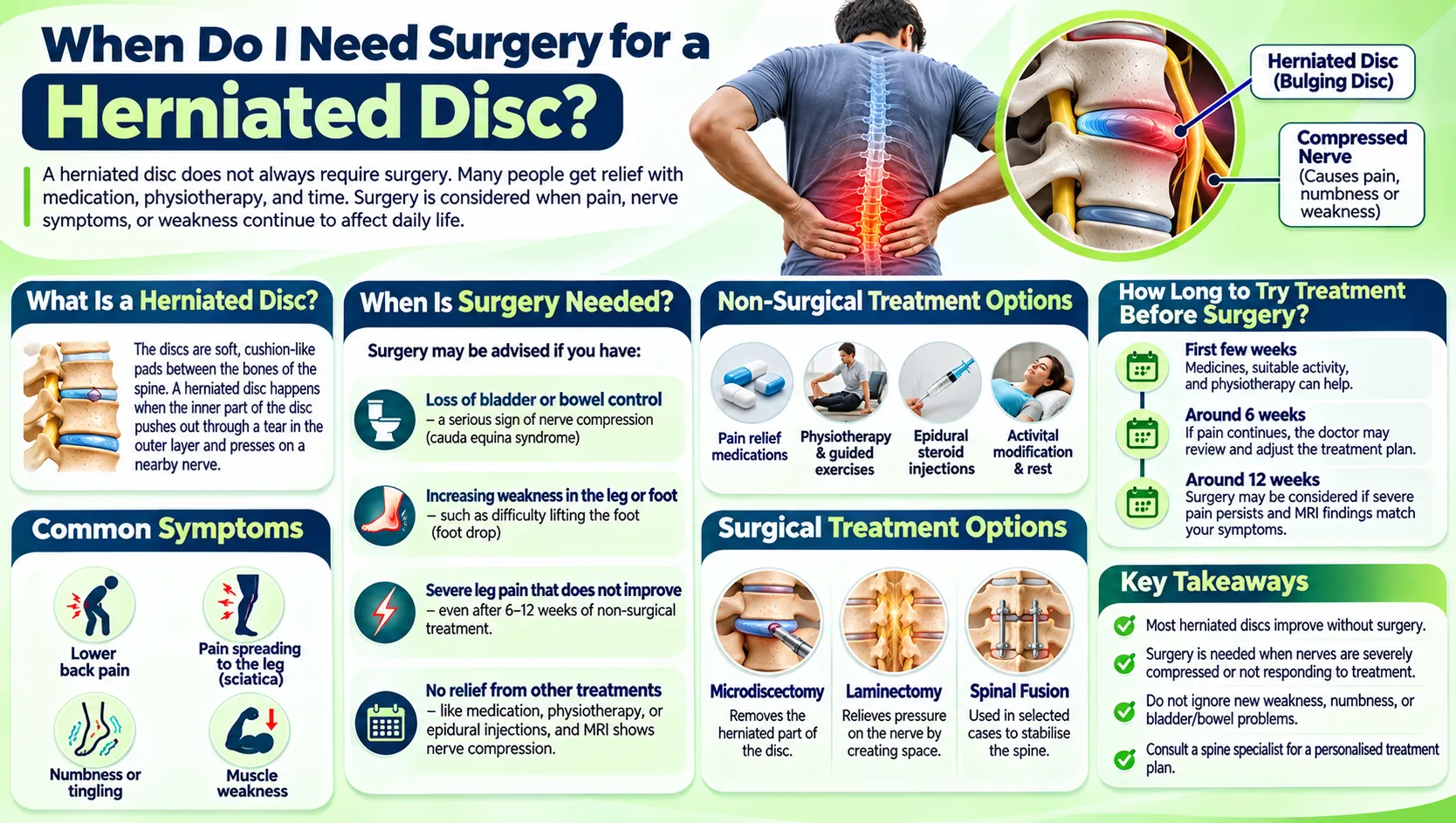
A herniated disc does not always require surgery. While some people can continue their daily activities with mild discomfort, others experience severe pain that makes sitting, walking, or working difficult. The difference often depends on whether the affected disc is irritating or compressing nearby nerves.
In many cases, medication, physiotherapy, and time can help relieve symptoms without surgery. However, persistent pain, worsening muscle weakness, or signs of nerve damage may require surgical treatment.
So, when do you need surgery for a herniated disc? Understanding the warning signs, available treatments, and the right time to consider surgery can help you make an informed decision.
Does a Herniated Disc Require Surgery?
Not necessarily. The majority of those suffering from a herniated disc should not undergo any surgical procedure.
The spinal discs provide cushioning between the vertebrae. When the inner core of the disc protrudes out of its outer shell, this condition is known as a herniated disc or slipped disc.
When the protruded substance pinches the neighboring nerve, the individual might experience pain in the lower back area, buttocks, or legs. Numbness, tingling sensations, and loss of strength can also happen.
Usually, the body begins to decrease the swelling around the affected nerve and may absorb a part of the herniated material. Thus, the symptoms become alleviated by themselves without the help of surgery.
According to various studies, about 80% to 90% of people show improvement in their condition through nonsurgical treatment options. That is why the doctor usually recommends other treatment methods first in case of no nerve damage.
Nevertheless, some patients may not wait for a while. For example, new urinary issues, numbness in the groin area, and rapid muscle weakness require immediate medical attention.
4 Situations When Surgery May Be Needed for a Herniated Disc
The decision is not based on the MRI report alone. Doctors look at the pain, muscle strength, nerve function, and how well the patient has responded to treatment.
1. Loss of Bladder or Bowel Control
This is one of the most serious warning signs.
Sometimes, a big herniated disc can put pressure on a collection of nerves in the lower part of the spinal canal. This is known as cauda equina syndrome.
Symptoms could include:
-
Difficulty urinating or inability to urinate.
-
Inability to control urination and bowel movements.
-
Numbness in the groin, buttock, or inner thigh region.
-
Weakness and numbness in both legs.
Emergency hospital evaluation is required for this condition. Doctors may arrange an emergency MRI and surgery.
It is necessary to get evaluated immediately and not wait for routine visits or take care of these symptoms at home using painkillers.
2. Increasing Weakness in the Leg or Foot
Pain and weakness are two separate issues.
Someone who suffers from nerve compression will have trouble lifting the forefoot, climbing steps, standing on tiptoe, or even walking without their leg buckling under them.
One of these symptoms is foot drop. It refers to the inability to raise the forefoot correctly, which results in dragging of the toes when walking.
When weakness is a new problem, or if it is getting progressively worse, it needs to be urgently evaluated by a spinal expert. In cases of significant weakness, emergency surgery may be needed to decompress the nerve.
3. Severe Leg Pain That Does Not Improve
There are those with back pain, with pain shooting down one limb. Such a condition is referred to as sciatica.
This can occur as an electric-like, burning, or sharp pulling pain. Symptoms can be triggered by such things as sitting, walking, coughing, or sneezing.
If pain persists despite use of drugs, physiotherapy, and other treatments that can work for a patient, a discussion regarding surgery can take place.
Surgery can be considered by doctors after 6–12 weeks of appropriate non-operative treatment if:
-
Pain is persistent.
-
Walking and sitting become hard.
-
Life and sleep are greatly affected.
-
MRI confirms compression of a nerve consistent with symptoms.
It is not necessary to wait for 12 weeks if there is nerve weakness during this period.
4. Non-Surgical Treatment Has Not Helped
Some patients adhere to their therapy but still suffer from pain.
This might be due to the use of medication, guided exercise, physiotherapy, as well as, in some cases, epidural steroid injections. In cases where the result is not achieved, and if MRI shows compression of the nerves, then surgery can become a reasonable choice to consider.
The purpose will be to decompress the nerve that causes the problem.
How Long Should You Try Treatment Before Surgery?
For someone who has pain but no serious muscle weakness or emergency symptoms, doctors commonly recommend around 6–12 weeks of non-surgical treatment before considering planned surgery.
This period gives the body time to recover and allows doctors to see whether the pain is settling.
However, the time can vary.
-
First few weeks: Medicines, suitable activity, and physiotherapy may help control symptoms.
-
Around 6 weeks: If pain is still affecting daily life, the doctor may review the treatment plan and discuss further options.
-
Around 12 weeks: If severe leg pain continues and the MRI findings match the symptoms, surgery may be considered.
Some people improve even after several months. Others may benefit from surgery sooner because of severe symptoms or nerve weakness.
Recent clinical reviews also highlight that the duration of pain matters. For people with sciatica lasting several months, microdiscectomy may provide better pain relief and improvement in daily function than continuing the same treatment without improvement.
The decision should still be made after examining the patient, not by following a fixed number of weeks.
What Treatments Are Tried Before Surgery?
Surgery for the removal of the disc material is not recommended unless the symptoms cannot be relieved by non-operative measures.
Treatment would depend on the symptoms experienced by the patient, their nerve function, and general health status.
-
Medication: Pain medication can be used to lessen the effects of pain. Pain relievers and anti-inflammatory drugs may be prescribed based on the health of the patient and other medications taken.
-
Physiotherapy: Exercises may be prescribed by a physiotherapist to make movement possible and to improve the muscle strength in the area of the spine. Exercises would vary according to the health of the patient. Any exercises that cause more leg pain need to be avoided.
-
Activity modification: Long bed rest is generally discouraged. Walking and changing positions regularly can be helpful. Heavy lifting and other activities that cause increased pain need to be avoided during recovery.
-
Epidural steroid injection: An epidural steroid injection may be recommended by the physician for some patients to reduce inflammation and provide relief temporarily. It does not remove the herniation of the disc but only provides temporary relief.
Failure of these therapies would result in surgery being recommended by a spinal surgeon.
What Are the Surgical Options for a Herniated Disc?
The operation depends on the location of the disc, the amount of pressure on the nerve, and whether the spine has any other problems.
Microdiscectomy or Discectomy
This is a commonly performed operation for a herniated disc in the lower back.
The surgeon removes the portion of the disc pressing on the nerve. The remaining disc is usually left in place.
The aim is to give the nerve more room and reduce pain travelling into the leg. A microscope or specialised instruments may be used to perform the procedure through a small opening.
Laminectomy or Laminotomy
In some cases, the surgeon needs to create more space around the affected nerve.
The lamina is a small part of the bone at the back of the spine. Removing a portion of it is called a laminotomy. Removing a larger part is called a laminectomy.
These procedures may be performed along with disc removal when extra space is needed.
Spinal Fusion
Spinal fusion joins two or more bones of the spine so they move together.
It may be considered when there is instability or another structural problem along with the disc condition. It is not routinely required for a simple, first-time herniated disc.
Artificial Disc Replacement
This surgery involves replacing the damaged disc with a prosthetic disc that allows movement between the bones.
This is possible for some patients, specifically some types of cervical disc problems. This surgery cannot be performed on all herniated discs.
The doctor will let you know which surgery you need and why. The idea is to take the pressure off the nerve without performing unnecessary surgery.
What Does a Recent Medical Update Say About Surgery Timing?
A period of 6-12 weeks has historically been used by doctors to evaluate the effectiveness of conservative treatment in patients who do not suffer from significant nerve weakness.
Current clinical guidelines issued in 2026 have put further emphasis on the time issue in cases where muscle weakness was observed.
The guidelines propose that:
-
Patients with moderate to severe muscle weakness require urgent assessment and prompt surgical intervention.
-
In selected patients with substantial weakness, decompression within 48 hours may enhance the probability of nerve recovery.
-
There is some evidence suggesting that surgery within several days could increase the chances of nerve recovery in patients with moderate to severe weakness.
-
Even mild muscle weakness requires proper evaluation, especially when it affects ambulation.
It should be noted that these time frames do not apply to every single case. It is important to consider the degree of weakness, its causes, and the examination results. The most important aspect of the guideline is that severe weakness should never be considered just another back pain problem.
What Happens If Surgery Is Delayed?
It all depends on the underlying reason for surgical intervention.
If there is no evidence of significant nerve impairment, urinary issues, or any other sign of an urgent issue, it would be reasonable to spend some time considering different treatment options. Some individuals improve without surgical intervention.
However, in cases of nerve impairment, the delay in treatment may affect recovery significantly.
Thus, the more time that passes between the onset of foot drop and the start of the treatment, the harder it becomes for a patient to raise their foot. In cases of nerve compression, even after its removal, muscle weakness will not be completely recovered.
Cauda equina syndrome is especially dangerous. Any bladder/bowel dysfunction or numbness in the groin area should require immediate evaluation.
In case of nerve damage that requires urgent surgery, make sure you understand the risks of delay.
How Does a Doctor Decide Whether You Need Surgery?
It is possible for two people to have a similar MRI report and yet require different treatment regimens depending on whether physiotherapy alone would suffice for recovery or whether surgery is required owing to progressive weakness.
For spinal problems, the spine expert will typically assess the following:
1. Symptoms: The doctor enquires about the site of the pain, the spread of the pain in the leg, and any presence of numbness and weakness. Walking abilities, sleeping habits, and the impact on the daily routine are evaluated too.
2. Nerve function: The doctor tests the strength of the legs, the reflexes, sensations, and walking. Inability to lift the foot and stand on the toes is an indication that a certain nerve root is affected.
3. MRI findings: The MRI results indicate the location of the herniated disc as well as its compression effect on the nerve root. The MRI results should correlate with the clinical findings.
If the MRI indicates the involvement of one nerve root and the symptoms involve the opposite side, the doctor will have to search for the underlying cause before recommending surgery.
Conclusion
Most herniated discs improve with non-surgical treatment, so surgery is not always necessary. However, persistent leg pain, worsening muscle weakness, or problems with bladder or bowel control should never be ignored. While some patients have time to explore treatment options such as medication and physiotherapy, others may need urgent surgical attention to prevent further nerve damage. Dr. Dheeraj Batheja, the Best Spine Surgeon in Gurgaon with 13+ years of experience, can evaluate your symptoms, review your MRI findings, and guide you towards the most appropriate treatment.
Frequently Asked Questions About Herniated Disc Surgery
1. How can you tell if a herniated disc needs surgery?
A herniated disc may need surgery if severe leg pain continues despite appropriate non-surgical treatment, or if there is significant or worsening muscle weakness. Problems with bladder or bowel control or numbness around the groin require emergency medical evaluation. MRI findings must also match the patient's symptoms.
2. Can you recover 100% from a herniated disc?
Many people recover well from a herniated disc without surgery. Pain, numbness, and other symptoms may improve as inflammation settles and the body gradually absorbs some of the herniated material. However, complete recovery varies depending on the severity of the condition and whether nerve damage has occurred.
3. How long can you go with a herniated disc before surgery?
Many patients can try non-surgical treatment for around 6–12 weeks before considering planned surgery. This may include medication, physiotherapy, and activity modification. However, significant muscle weakness or emergency symptoms may require earlier intervention. The timing depends on the patient's symptoms and nerve function.
4. Does an L4-L5 disc bulge require surgery?
No, an L4-L5 disc bulge does not automatically require surgery. Many people manage their symptoms with medication, physiotherapy, and lifestyle changes. Surgery may be considered if there is persistent nerve-related pain, significant weakness, or nerve compression that does not improve with appropriate treatment.
5. How painful is a herniated disc on a scale of 1 to 10?
The pain from a herniated disc varies from person to person. Some people experience mild discomfort, while others report severe pain that affects walking, sitting, and sleeping. Pain severity depends on factors such as nerve irritation, the location of the disc, and individual sensitivity.
6. How risky is back surgery for a herniated disc?
Back surgery for a herniated disc is generally considered safe when performed for the right reasons, but like any operation, it carries risks. These may include infection, bleeding, nerve injury, spinal fluid leakage, or recurrent disc herniation. Your surgeon can explain the potential benefits and risks based on your condition.