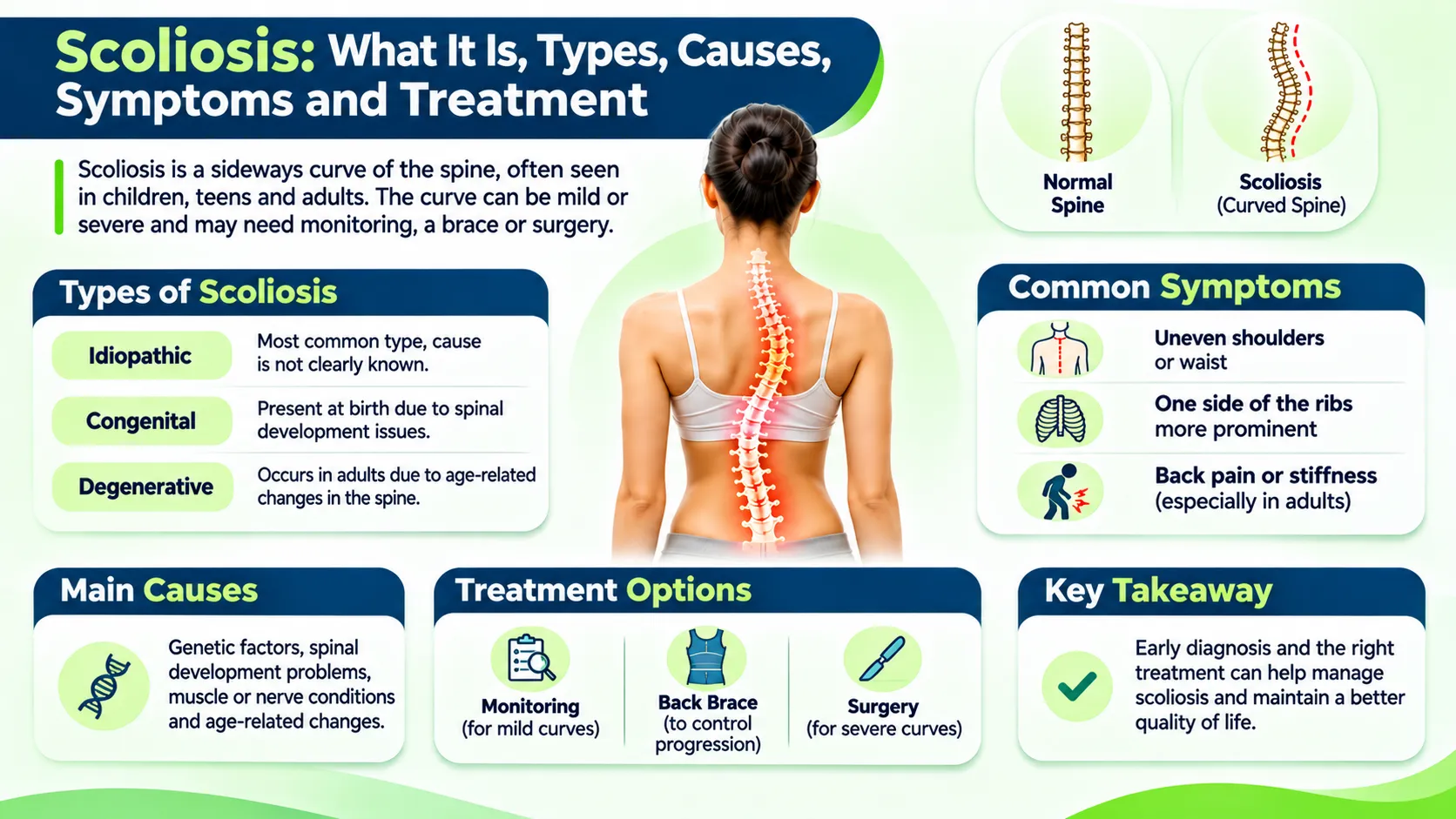
Scoliosis is a side-to-side curve of your spine. This differs from your body’s natural front-to-back curve. It’s usually mild and doesn’t cause symptoms, but it can lead to back pain and abnormal posture. A healthcare provider most often diagnoses this condition during adolescence. Treatment includes physical therapy, braces and surgery.
What Is Scoliosis?
The backbone consists of small bones known as vertebrae. In normal people, the backbone is seen as perfectly straight when observed from behind. However, in those individuals who have scoliosis, the spinal column takes on a curved shape, forming an S or C shape. There may also be a rotation of the bones, leading to one side of the ribs and back appearing more prominent.
A Cobb angle test is done using an X-ray. Here, the measurement of the curve is done. This refers to a curve of 10 degrees or more.
A mild scoliotic curve will not lead to pain or interfere with everyday activities. It is the more significant curves that alter the appearance of the waist, shoulders, and hips. Severe cases may even alter the available space for the lungs.
What Are the Different Types of Scoliosis?
Scoliosis is grouped according to what causes the curve and when it develops. The following are the main types doctors commonly discuss.
1. Idiopathic Scoliosis
This is the most prevalent form. Idiopathic literally means that no definite cause for the problem has been identified by doctors.
It usually occurs at a time when kids grow rapidly. It normally develops at an age between 10 and 18, but it can also be found to occur earlier than that.
Idiopathic scoliosis can be hereditary. If someone in your family, such as your parent, brother, or sister, has had this condition, you may be at risk of having it yourself.
2. Congenital Scoliosis
Some babies are born with scoliosis, in which one or more of the bones that make up the spine fail to form or to separate as the child develops inside the womb.
Progression of the curvature may become apparent either from birth or early in the years of childhood, depending on the particular nature and position of the bone abnormality.
Individuals who suffer from congenital scoliosis will need to have their other possible complications assessed as well, especially those associated with the spine, kidneys, and heart.
3. Neuromuscular Scoliosis
The muscles and nerves help keep the spine supported. When a medical condition affects these muscles or nerves, the spine may gradually develop a sideways curve.
Neuromuscular scoliosis can occur in people with conditions such as:
-
Cerebral palsy
-
Muscular dystrophy
-
Spina bifida
-
Spinal cord injuries
The curve may become more noticeable as the underlying condition affects muscle control and support. These patients may need regular monitoring and a treatment plan that considers their overall health and mobility.
4. Degenerative Scoliosis
This type is mostly found in adults as their spines age. The spinal discs and tiny joints present between the vertebral bones tend to deteriorate unequally. Therefore, the spine starts to get bent on one side.
The condition can be found in the lower back and can come with either disc degeneration or spinal stenosis.
Individuals suffering from degenerative scoliosis are likely to have back pain, stiff backs, leg pain, or trouble walking.
5. Functional Scoliosis
Functional scoliosis differs from the other types of scoliosis in terms of structure. The reason for the curve of the spine lies in some other issue, such as a shorter leg on one side or a muscle spasm.
The bones themselves do not have any structure that gives them a curve.
For a specialist to diagnose the type of scoliosis, he or she should examine both the spine and the whole body of a patient.
What Are the Causes of Scoliosis?
The cause depends on the type.
In most children with idiopathic scoliosis, doctors cannot point to one particular reason. Family history and genetic factors may play a role. The curve often becomes noticeable during a growth spurt.
Other causes include:
-
Problems during spinal development: Some vertebrae may not form properly before birth.
-
Nerve or muscle conditions: Conditions that affect muscle strength and control can change the support around the spine.
-
Age-related changes: Uneven wear in the discs and joints can lead to a curve in adults.
-
Leg-length difference or muscle spasm: These can cause a temporary sideways bend rather than a fixed spinal deformity.
Parents often worry that a heavy school bag, poor sitting posture or sleeping position has caused their child's scoliosis. These are not considered causes of idiopathic scoliosis.
What Are the Symptoms of Scoliosis?
A mild curve may not cause any pain. In many children, the first sign is a change in the way the back or waist looks.
Look for these changes:
-
One shoulder appears higher than the other.
-
One shoulder blade sticks out more.
-
The waist looks uneven.
-
One hip sits higher or appears more prominent.
-
The body leans slightly to one side.
-
One side of the ribs looks raised when the person bends forward.
-
Clothes seem to hang unevenly or fit differently on each side.
Can Scoliosis Cause Back Pain?
Yes, but the experience is different for children and adults.
In mild cases of scoliosis among children, there is usually no pain. Back pain and stiffness may occur among adults, especially if age-related degenerative changes are also a factor.
Any pain or numbness extending into the legs indicates pressure on the nerves of the spine, and this should not always be attributed to scoliosis. Other possibilities need to be ruled out by a doctor.
Can Scoliosis Affect Breathing?
Those who suffer from mild to moderate forms of scoliosis generally do not experience difficulty breathing.
An exceptionally large curvature of the upper or mid-back area may cause the structure of the ribcage to change, limiting the available space for the lungs to function normally. This issue affects breathing only in serious instances.
Difficulties breathing must always be checked by a medical professional rather than automatically linked to spinal curvature.
How Is Scoliosis Diagnosed?
The doctor will start by examining the back, shoulders, waist, and hips. Sometimes, the patient will be asked to stand up and then bend forward to see whether one side of the back or the ribs is higher than the other side.
One of the most common examinations is called the Adam's Forward Bend Test. The patient bends at the waist with his/her feet together. The doctor will examine whether there is an unevenness of the rib cage or an elevated part of the back.
X-rays are needed to diagnose scoliosis and measure the curve. This measurement is called the Cobb angle.
This angle describes the curvature but does not always determine the course of action, as the doctor will also consider the patient's age, bone maturity, and changes in the curve compared to the previous visits.
MRI may be ordered by the doctor in case they suspect any problems with the spinal cord or nerves, or if the symptoms do not coincide with the standard ones.
What Are the Different Degrees of Scoliosis?
Doctors use the Cobb angle to measure the sideways curve. The following ranges are commonly used to describe its size.
|
Cobb angle |
General description |
|
Less than 10 degrees |
Spinal asymmetry; not usually classified as scoliosis |
|
10–25 degrees |
Mild scoliosis |
|
25–40 degrees |
Moderate scoliosis |
|
Above 40–45 degrees |
Severe scoliosis |
These ranges are general guides, not treatment rules. A child with a smaller curve who is still growing may need close monitoring because the curve could increase. An adult with a larger curve may have no major symptoms.
The speed of change also matters. A curve that is increasing needs more attention than one that has remained stable.
What Is the Treatment for Scoliosis?
Not everyone with scoliosis needs treatment. Some people only need regular check-ups to see whether the curve is changing.
The treatment plan depends on the size of the curve, the patient's age, remaining growth and symptoms.
1. Regular Monitoring
In the case of a mild scoliosis curve, only monitoring may be required. Monitoring involves regular visits to the doctor as well as possibly periodic X-rays to determine if the curve becomes worse.
Children who have not yet stopped growing require more frequent monitoring than grown-ups. No active therapy will be required if the curve remains stable.
2. Back Brace
Bracing may be recommended if the spine is still growing and a curve reaches a degree when it may worsen.
Bracing prevents worsening of the curve but does not always help straighten the spine.
The type of brace used is determined by the location and size of the curve. The patient has to wear the brace most days, and regular fittings are essential as the body develops.
Bracing becomes much less effective once the spine stops growing.
3. Physiotherapy and Exercises
Physiotherapy may assist in muscle strengthening, mobility, and fitness. A physiotherapist could recommend exercises appropriate to the patient's curve, age, and level of physical activity.
For some patients, exercises specifically designed for scoliosis treatment, e.g., the Schroth exercise therapy, may be recommended.
Exercises help with strength and ease of mobility; however, exercise programs cannot guarantee correction of any structural deformity of the spine. Most people with scoliosis can stay physically active and participate in sports unless there are other medical contraindications.
4. Pain Management in Adults
For adults suffering from scoliosis, back pain treatment may be necessary. If the reason for the pain is the deformity of the spine, appropriate medication, physiotherapy, physical activity modification, or spinal injections may be considered.
In case the back pain is caused by spinal canal stenosis or compression of nerves, additional treatment for this condition would be required.
5. Scoliosis Surgery
It can be recommended in cases of significant scoliosis that progresses and leads to considerable imbalance or impairs neurological functions. Surgery is usually considered in adolescents and children when the curvature exceeds 45-50 degrees, depending on the specific case.
Spinal fusion is one of the surgical interventions. During the procedure, the physician places screws and rods along with bone grafts to straighten the spine and fuse several vertebrae.
Every large curvature necessitates surgical treatment. Different factors are considered, including age, general health status, and the probability of progression.
Can Scoliosis Be Prevented?
The condition of idiopathic scoliosis cannot be prevented most of the time. It is not due to poor posture, carrying a backpack unevenly, or a lack of physical activity.
Parents can take notice of any change in the shoulders, waist, or back while the body is developing. In case there is a difference in one side of the body compared to the other, it is best to consult a doctor to make sure that the development of the spine is normal.
Children who have been diagnosed with scoliosis must keep up with their appointments, especially during growth periods.
Conclusion
Scoliosis can range from a mild spinal curve that only needs regular monitoring to a more severe condition that may require bracing or surgery. The right treatment depends on factors such as the degree of curvature, age, symptoms, and whether the spine is still growing. Even without pain, changes like uneven shoulders, prominent ribs, or an uneven waistline should not be ignored. Dr. Dheeraj Batheja, the Best Spine Surgeon in Gurgaon with 13+ years of experience, can evaluate spinal curvature and recommend an appropriate treatment plan.
Frequently Asked Questions
Can one suffering from scoliosis have a normal pregnancy?
The majority of females with scoliosis can have a normal pregnancy and delivery. It all depends on the severity of the curve, prior spine surgeries, and the presence or absence of back or neurological symptoms. Females who have undergone spinal fusion should review their medical background with the obstetrician and anesthetist.
Does scoliosis affect a person’s height?
A bigger spinal curve can cause a decrease in height since the spine is no longer in a straight position. Everything depends on the degree and location of the curve. Small scoliosis affects a person’s height very slightly.
Can a person with scoliosis join a gym?
In most cases, the answer is yes. Individuals who suffer from scoliosis can work out and perform physical activity. One just needs to find out the appropriate exercises according to one’s condition, especially if there are any pains and spinal surgeries.
Can scoliosis impact life expectancy?
Individuals with mild and moderate cases of scoliosis do not experience life expectancy abnormalities. Medical complications are rare, but extreme cases, especially those that impact breathing or are accompanied by other medical conditions, require more medical attention.
Can scoliosis worsen after a person has stopped growing?
There are cases where the curves are stable once an individual has reached adulthood. Curves over 40-50 degrees can still worsen in adulthood. Adult patients diagnosed with scoliosis should seek medical consultation in case of changes in posture or symptoms.
Related services