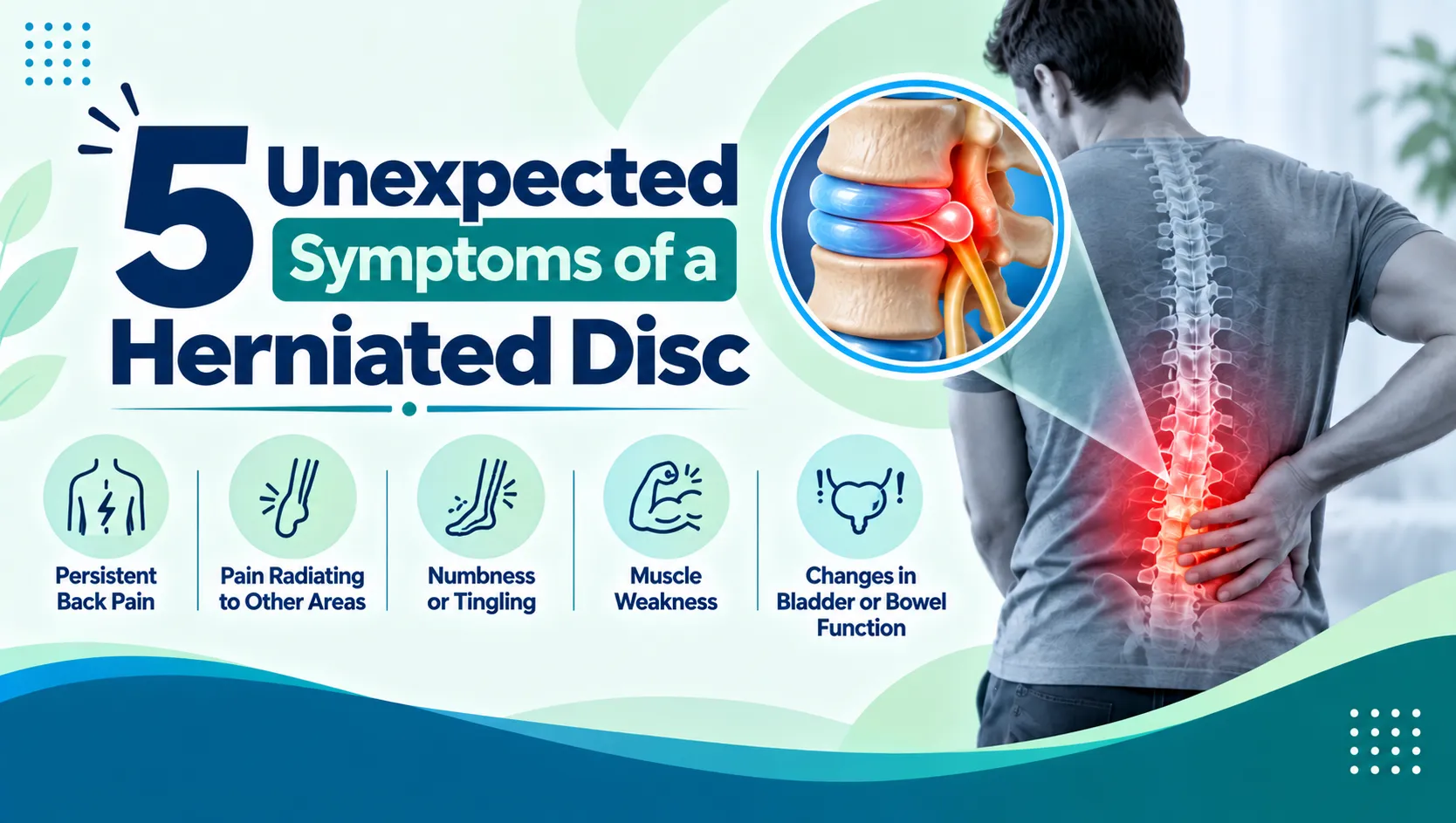
Most people associate a herniated disc with back or neck pain, but its symptoms can sometimes appear in less obvious ways. A herniated disc can cause surprising issues like electric shock sensations, hand or foot numbness, weakness, or pain that becomes worse when coughing or sneezing. This happens when the damaged disc irritates or compresses a nearby spinal nerve.
Depending on which part of the spine is affected, symptoms may travel into the arm, hand, leg, or foot—even when back or neck pain is mild or absent. For example, a herniated disc in the lower back may cause pain or numbness down the leg, while a cervical disc problem can affect the arm, hand, or fingers.
In this article, we'll explore 5 unexpected symptoms of a herniated disc, why they occur, and when these symptoms should be evaluated by a spine specialist.
1. Pain That Travels Down Your Leg or Arm
People often think that issues with spinal discs will cause problems only in the specific location of the disc. This is not always the case. Irritation of a disc can be the source of pain, but the pain can be referred to other locations if the disc is pressing on a nerve.
With a herniated lumbar disc, pain can be located in the low back and buttocks and can refer pain down the back of the thigh and calf and can even get into the foot. This is often referred to as sciatica. With disc problems, pain is often described as a burning or electric shock type of pain.
Disc problems at the cervical level are often referred to as a pinched nerve. This can cause pain in the neck, arm, and even the fingers. Again, in this case, people often describe having more radiating pain in the arm and little pain in the neck.
Pain in general can be made worse with movement, coughing, or sneezing.
2. Tingling or Numbness in the Foot, Leg, Hand or Fingers
A strange tingling sensation can be easy to ignore.
It can be described as feeling pins and needles, or as a part of your foot, leg, hand, or finger being numb because a disc is herniated in relation to the spine.
For example, a person with a lower back disc problem may feel numbness in part of the leg or foot. With a neck disc problem, the sensation may travel into the arm or fingers.
The location of the numbness can give a doctor useful information about which nerve may be involved.
3. Weakness in a Leg or Hand
Weakness is more difficult to recognize than pain; hence, this symptom may sometimes remain unrecognized at first.
Compressed nerves affect the muscles that they supply. One may find that one leg is less steady, the foot cannot be raised, or it is difficult to stand on the toes. In case of a cervical disc problem, one will experience problems such as holding objects, raising an arm, or using hands normally.
This may become obvious only when a person is involved in his/her daily activities. This can include an inability to hold objects, drag a foot, or climb stairs.
Any change in muscle weakness is a symptom that requires medical attention, especially if it affects one’s walking ability or hand usage.
4. Trouble With Balance or Walking
A herniated disc can manifest in various symptoms apart from the commonly known back and leg pain.
In the case of a herniated disc in the neck, if the disc is pushing against the spinal cord, symptoms can be more widespread. It can affect the arms and legs and can affect the function of fine hand movements.
You may begin to stumble, have problems with balance, and/or have problems with other activities requiring fine hand movements, like writing.
This type of symptomatology should not be explained away as "simple" or "ordinary" back pain.
It is always important to have a thorough medical evaluation by a qualified physician to determine the exact cause of symptoms.
5. Changes in Bladder or Bowel Control
This is uncommon, but it is one of the most important symptoms to know about.
A large disc herniation in the lower back can rarely put pressure on a group of nerves called the cauda equina. These nerves are involved in the movement and sensation of the legs and also help control the bladder and bowel.
Warning signs can include:
-
Difficulty passing urine
-
New loss of bladder control
-
Loss of bowel control
-
Numbness around the inner thighs, buttocks or genital area
-
Severe or rapidly worsening weakness in the legs
These symptoms need urgent medical attention. Cauda equina syndrome is a medical emergency, and delaying treatment can lead to permanent nerve problems.
Can You Have a Herniated Disc Without Back Pain?
Yes.
A herniated disc can be asymptomatic in some individuals. When a disc is not irritating a nerve, an individual can be pain-free or experience very mild symptoms. In fact, in some instances, a herniated disc is diagnosed accidentally through imaging studies ordered for another condition.
In the case where there is an irritated nerve, symptoms can manifest at a location distant from the spinal region. That is why, in some cases, one can have leg pain without significant back pain or symptoms in the arm/hand without much neck pain.
When Should You See a Spine Specialist?
Not every case of leg pain, numbness or tingling is caused by a herniated disc. Similar symptoms can occur with other nerve, muscle or joint problems.
It is worth getting checked if:
-
Pain keeps travelling into your arm or leg
-
Numbness or tingling continues or gets worse
-
You notice weakness in an arm or leg
-
You are having trouble walking or maintaining balance
-
Symptoms are affecting your daily activities
-
Pain is not improving with basic treatment
A doctor may check your muscle strength, reflexes, sensation, and movement. Depending on your symptoms, an MRI scan or other tests may be recommended to understand whether a disc is pressing on a nerve.
What Happens If a Herniated Disc Is Confirmed?
Finding a herniated disc on an MRI does not lead directly to the conclusion that surgery is needed.
Many patients with a herniated disc and associated symptoms and signs get better with non-surgical treatment. Treatment may consist of pain relief and other medicines, activity change, and physical therapy and exercises.
Indication for surgery are persistent, treatment-resistant signs and symptoms of nerve root compression with or without cauda equina syndrome.
Treatment of patients with a herniated disc should not be based on the MRI results alone. Other factors, including the patient's symptoms and physical examination, should be taken into account.
Final Thoughts
A herniated disc does not always cause obvious back or neck pain. Symptoms can sometimes appear farther along the affected nerve, causing radiating pain, numbness, tingling, weakness, or difficulty with walking and balance. While bowel or bladder changes are rare, they can indicate serious nerve compression and require urgent medical attention.
If you experience persistent or worsening pain, numbness, tingling, or weakness in your arm or leg, it is important to have the symptoms properly evaluated rather than assuming they are caused by a herniated disc. Dr. Dheeraj Batheja, best spine surgeon in Gurgaon, can assess your symptoms, identify the underlying cause, and recommend an appropriate treatment approach based on your condition.
FAQs
1. Can a herniated disc cause pain without back or neck pain?
Yes. A herniated disc can irritate a spinal nerve and cause pain, numbness, or tingling in the arm or leg even when back or neck pain is mild or absent.
2. Can a herniated disc cause weakness in the foot or hand?
Yes. Nerve compression from a herniated disc can cause muscle weakness, such as difficulty lifting the foot, standing on the toes, gripping objects, or raising the arm.
3. Can a herniated disc cause tingling or numbness in the fingers?
Yes. A cervical herniated disc can irritate nerves that travel into the arm and hand, causing tingling, pins-and-needles sensations, or numbness in the fingers.
4. Can coughing or sneezing make herniated disc pain worse?
Yes. Coughing, sneezing, or straining can temporarily increase pressure around the affected nerve and may make radiating pain more noticeable.
5. Can a herniated disc cause problems with balance or walking?
It can, particularly when a cervical disc problem affects the spinal cord. Balance difficulties, frequent stumbling, or changes in hand coordination should be medically evaluated.
6. Can a herniated disc affect bladder or bowel control?
Rarely, a severe lumbar disc herniation can compress the cauda equina nerves and affect bladder or bowel function. New bladder or bowel problems, especially with numbness around the groin or severe leg weakness, require urgent medical attention.
7. Does a herniated disc always require surgery?
No. Many people improve with non-surgical treatment such as activity modification, medication, and physical therapy. Surgery may be considered when symptoms persist despite treatment or when significant or progressive nerve problems occur.
8. How is a herniated disc diagnosed?
Diagnosis usually involves a medical history and physical examination. Depending on the symptoms and examination findings, imaging such as an MRI may be recommended to assess the discs and nerves.
9. Can a herniated disc heal on its own?
Yes. Some herniated discs improve over time as inflammation decreases and the body gradually resorbs part of the disc material. Treatment depends on the symptoms and neurological findings.
10. When should you see a doctor for a suspected herniated disc?
Seek medical evaluation if pain keeps radiating into an arm or leg, numbness or tingling persists, weakness develops, or symptoms interfere with walking or daily activities. New bladder or bowel problems require urgent assessment.